
Football
The 2026 football activities starts in March!
JoMoni organizes a football group for those over 16 years old, as well as school-aged children (13-16).
No registration required.
We do not have joint insurance. Players participate at their own risk.
Football activities have been sponsored in 2026 with the assistance of the City of Joensuu's resident participation .
All JoMoni activities are smoke-free and follow safe space principles .
For more information, contact the coach Karl Hancock: karl.hancock@jomoni.fi.
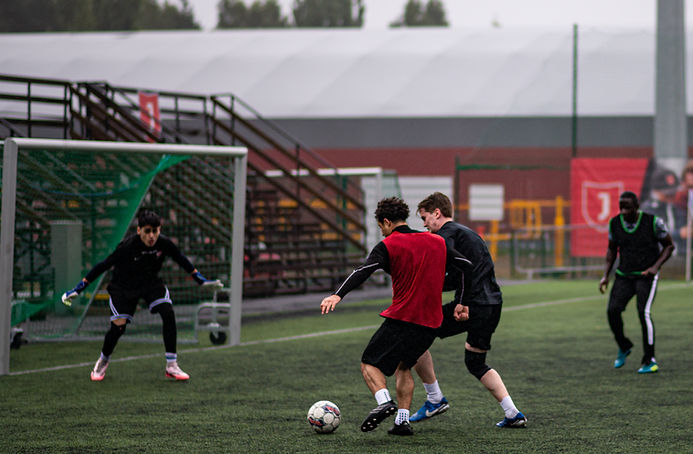
Make sure to check out the photos from the football trainings below!


Photographer: Elena Maltseva
Instagram: @content.photo.fi
Q&A
with
Karl Hancock
Interview by: Elena Maltseva

Personal story
Why football?
Football is both a great way to keep fit and a way to meet people, find friends and have fun. Beyond that, it’s a sport that connects you to people globally, regardless of which team they support.
If you love football, you have a connection with people. It provides a common language and an easy way to start a conversation with almost anyone.
What does football mean to you personally?
Football has been a major part of my life since I was very little. There is even a photograph of me at the age of four with a football kit on. By the time I was nine, I had started playing for the school team.
I'm from Manchester, and I have that identity of being a Manchester United fan. I've played, coached, and enjoyed football video games, so in general, it has always been much more than just a sport to me.
What does the phrase “Meille Saa Tulla” mean to you personally?
To me, “Meille Saa Tulla” means that you are welcome here as you are. It’s about finding a way to get along. The goal is to come without any prejudice or negative thoughts about others before you even meet them.
As an immigrant myself in Finland, it represents this attitude to me – welcoming people with open arms, no matter where they are from, their background, or the language they speak.
Have you ever experienced difficulties because of where you come from?
I think the major issue is the language. You do lose a bit of independence when you come to a country where you can't speak the native language fluently.
I don't speak completely fluent Finnish. I felt a little bit of an inconvenience because everybody else has to speak English to communicate with me properly. But there's not that sort of feeling like I can't get by here.
Is there something that's affected the way you work with people?
I've always been open-minded towards different cultures and believed in treating everyone simply as human beings.
But this experience has deeply influenced my approach to life in general. The more people I meet from different backgrounds, the more it helps me relax and see the world as a big place. There are billions of people on the planet, and life here is just a small part of that.
Because of this, I never want to make others feel like I'm better than them – I don't think that's a healthy attitude.
You give a lot of your time and energy to this work. What have you learned from the people who come to play? Has this work changed you in any way?
I am privileged to do what I do. I love meeting people from all over the world. I'm fascinated by their stories and lives. Over time, this work has enabled me to build friendships.
When I walk out on the streets in Joensuu, I very often meet people who just say hi. It feels like I have this wonderful community of people who are supporting me and are on my side just as much as I'm on theirs. This work has given me so much in my life, and I am truly honoured to do it.


Football training
The values and philosophy
Our weekly football group, like all JoMoni activities, is completely open to everyone.
We have a strict zero-tolerance policy for violence, racism, and discrimination, ensuring a safe and welcoming space for all. We don't tolerate any negative behaviour towards anybody.
We embrace a true mix of ages and abilities, including people who have never even kicked a ball before. To keep things balanced, experienced players guide the beginners rather than making them feel bad about mistakes.
While there is a natural competitive spirit, everyone understands it’s not that serious. We play to win, but there are no trophies or points. It's a very safe and supportive environment where people can come in.
Off the field, you get the chance to connect with teammates, feel encouraged, and leave with a positive mindset – especially if you managed to score or save a goal.
How does football change the lives of people who come to JoMoni training every week?
After nearly nine years of doing this work, I can see that these sessions have become an important part of their lives. People look forward to them all week because it's a chance to connect with others from the same background, country, or language group.
It offers so much more than just an opportunity to stay fit. It helps with feelings of isolation and loneliness, reminding them that they are not alone here.
Have you seen any unexpected changes in someone's life?
Often, interactions have led to stronger friendships. We've seen guys build connections, even creating their own groups to meet up, support each other, play games, or just chat.
In other cases, these connections have directly led to potential internships or job opportunities. It truly is an opportunity to make a lasting impact on someone's life – it goes far beyond just the sport that is played.


The tournament
For someone who's never been to a JoMoni event. How would you describe the atmosphere?
The main message that we always try to push with this tournament is that it is obviously an anti-racism tournament that tries to promote cultural diversity.
The atmosphere is completely open, relaxed, and chilled out. People are not restricted by skill level, age, or gender – everyone is welcome. We hope participants truly see and feel that. At the same time, everything is handled professionally to ensure that it's a safe space for everyone.
Our tournaments are always positive and really interesting experiences. When teams are resting between matches, people naturally engage and talk about things far beyond football. People even bring their families, so there are often children around.
What are you missing if you decide to stay at home?
JoMoni events are a great opportunity to see the true diversity present in Joensuu and how that diversity is actively growing here. And so I think that's the first thing that you would miss out on if you stay at home.
You miss the chance to feel how diversity can be a positive thing. It’s not something to be feared or to be worried about, but something that can bring people together and show how well we can all get along.
Beyond that, you miss out on a great day of competitive football, whether you're a fan or not. You miss seeing the post-match handshakes and the shared respect. Ultimately, attending broadens your mind and changes the way you see the world.
Is there someone who might think – this event is not for me; football isn’t for me; I'm not a good enough player; I don’t know anyone there? What would you say to that person?
The football itself is the main part of the day, but it is played at an amateur level. It won’t be as fast as a professional match.
You'll see a mix of ages and abilities, and possibly even mixed genders playing together. It's going to be entertaining, making it well worth coming out to watch and follow.
Football can bring people together, but it can also create strong emotions and arguments. How do you keep the atmosphere friendly and respectful?
Sometimes it's not always going to be smooth. You can get some arguments and aggression on the field. But football can give this sort of structure to learning how to be together. The rules around football can help to navigate challenges, and boundaries on the field help people learn how to behave and how to treat each other.
Football events like our tournaments can certainly help highlight that and demonstrate that as well in the community.

Joensuu and the positive impact
What does a multicultural football event bring to Joensuu? Why do you think it is important here?
A multicultural football event reflects how Joensuu is growing and changing. Diversity is a positive thing, and football naturally embodies that.
Football is a very multicultural sport, even at the professional level. Even top teams have players from all over the world on the field. Our local team, JIPPO, also includes international players, so the same diversity can be seen on the field there too.
How did the local community help?
Elinvoimakeskus, supporting us financially as well.
The city of Joensuu has been funding us for a few years now. They fund our football activities and also the tournament “Meille Saa Tulla”. We are very grateful to the city of Joensuu for that, and for helping us out with field bookings and so on.
JIPPO, the local football team in Joensuu. They provided us with a grill last year. They've given us some free tickets to give to the football participants, because there's a real connection with the football community in Joensuu.
This year, local team FC Union will be providing footballs for the tournament, so a big thanks to them.
The referees' association of North Karelia Pallopuntari (Erotuomarikerho Pallopuntari ry) provide referees. We have a really good relationship with them.
There are a number of Finnish local teams, local informal groups, who participate each year. We have one team called PSV Noljakka, who have participated ever since I've started doing this.
They are always very supportive, and that support has been changing and increasing as we've been moving forward.